
From Sail to Power: The differences in travel time

Amy Babinchak has been a GLCC member since 2014. She is a Club Director and Port Captain for St. Helena Island, MI (M-71). She is a lifelong boater. This is the first of several articles addressing her switch from sail to power.
By Amy Babinchak, Port Captain/Director
The Great Lakes and I have always been friends. I didn’t always know it. I started my boating career nearly from birth on my parents’ boat, a 34-foot ChrisCraft cruiser, and others they provided for me on a canal off Lake St. Clair (that wide spot in the waters between Lake Huron and Lake Erie).
As a kid, I moved from a SportYak to a paddleboat to a 14-foot wooden Thompson to 22-foot ChrisCraft runabout. I swam, I rowed, I fished and skied daily. I was the water and the water was me. I was that kid anchored off Lake St. Clair’s Poor Man’s Beach, Strawberry Island, or sneaking into Metropolitan Beach by landing our boats out of direct sight and skiing everywhere every summer morning, usually with a small group of boats captained by other 12-year-olds. Perhaps a nightmare by today’s standard but a norm in the late 1970’s and early 1980’s.
I later went away to Michigan State University in East Lansing, the comparatively arid center of Michigan. To me, it may as well have been the Sahara. For the first time in my life, I didn’t have a boat and ready access to water, except for bonfires along the Cedar River and swimming in the Grand River once my car was on campus.
I did eventually adjust but still, after graduating and landing my first job, I called my father and said I want to buy a sailboat. Two weeks later, he called to say he found one. I convinced my mother to bankroll the $8,000 to buy it and, without a second thought Missy Siudara, my future wife and I, tied up S/V Fidders Green, a Newport 27, to the sea wall behind my parent’s house.
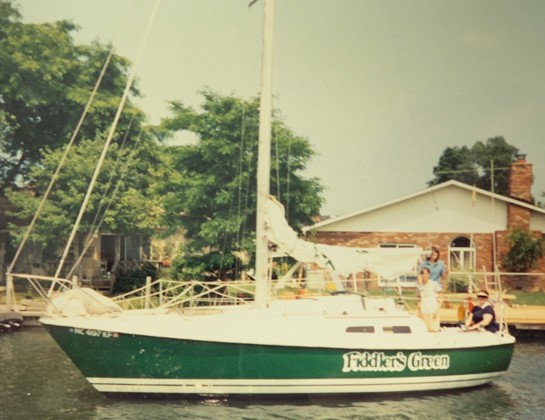
Why a sailboat? Because I was poor, just starting my life and knew I couldn’t afford fuel. The solution to a lack of funds was a boat that didn’t require much feeding. When the sails went up for the first time on S/V Fidders Green and she powered forward, I thought WOW!, this is what centuries of engineering feels like! We took off for Lake Erie the next week and learned how to sail the boat on the way.
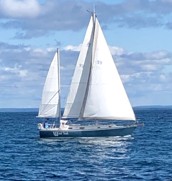
We had many adventures over the following 30 years, sailing on four of the five Great Lakes in that Newport 27, and then doing it again with more comfort and less drama on S/V Windtrail, our Pearson 365 Ketch. Only Lake Ontario still eludes us.
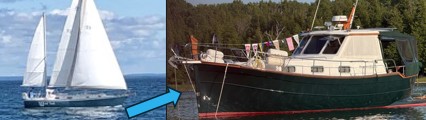
We’ve now moved to a 36’ motoryacht, M/V Sonador, an import from Spain and the only Menorquin 110 on the Great Lakes that I’m aware of and one of few in the US.
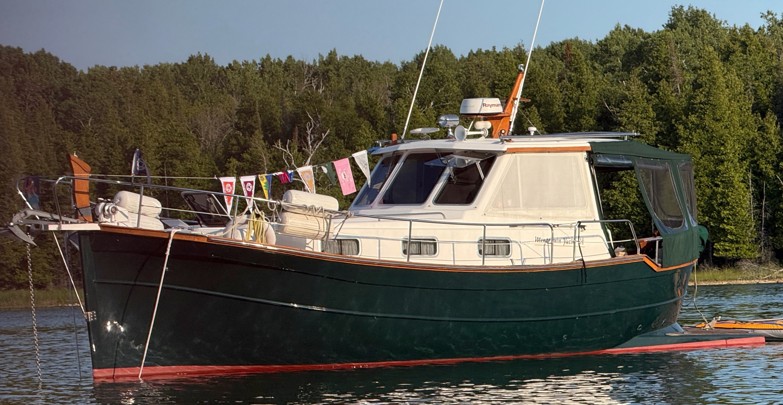
Because of the shift from sails to engines, we’ve been learning a lot. So much that it occurred to me that while many sailors eventually make this transition, no one tells you what to expect.
This article is the first of several chronicling my transition from the world of sailboats to that of powerboats. It has been a journey as much about personal evolution as nautical know-how. I begin with one of the most immediately striking and obvious contrasts — the time it takes to get from place to place.
Speed and time
When sailing: To travel by sail is to surrender to the elements. Every journey is governed by the wind’s direction and strength. On a good day, our ketch could make 6 knots; on a bad day, progress was measured in patience rather than miles. A crossing that looked straightforward on the chart — a mere 30 nautical miles — might span the better part of a day, or more if the wind faltered and we were feeling stubborn about starting the engine or if the wind and waves were coming in a non-optimal direction and we had to zig-zag. Planning a trip meant careful weather-watching, flexible itineraries, and a willingness to accept delays as part of the adventure.
When powerboating: The first time I piloted M/V Sonador, the sensation was one of both fear and familiarity. Gone was that secure feeling that thousands of years of engineering brought to sailing, but still with me was the confidence of knowing the Lakes and feeling them within me.
We have dual engines, and we travel without effort at 10 knots from the moment we clear the exit channel markets until we reach the entrance of our destination. With reliable engines humming beneath me, distances collapsed. That same 30-mile journey was reduced by half. Sounds great, doesn’t it? But … .
Powerboating means that dead-reckoning points, buoys, and GPS waypoints all come at you at double the speed you’re used to. It’s not exactly a problem but it does mess with your brain, more than you’d think. If you have a familiar destination that is four hours away by sailboat and suddenly it’s only two hours, it feels like the world just got smaller, you’ve entered warp speed or just come through a wormhole in the universe. You think to yourself: We’re here already?
Comparing experiences
- Trip planning: With a sailboat, planning is an exercise in contingency. With a powerboat, it becomes a matter of calculation balanced with a new-found vulnerability.
- Getting going: Throw off the lines, stow them away. Sit down. That’s the total of our new off-the-dock process.
- Flexibility: Powerboats offer the ability to make spontaneous changes easier. For example, this summer we intended to stay overnight at Kagawong, ON, only to find there was no slip available. So, we took a day berth and then drove the 1.5 hours back from where we came. In the sailboat, that would have been a 3 or 4-hour return and a different decision process.
- Distance: Destinations once considered “too far for a weekend” suddenly became accessible.
- Rhythm: The leisurely tempo of sailing that requires our minds to be engaged has faded into more of a road trip experience.
A new relationship with the Lakes
Trading the wind for horsepower reshaped my horizons, literally and figuratively. The luxury of speed opens new doors, but it also invites reflection. The rush of arrival came at the expense of the journey’s slow unfolding, and more than once I found myself nostalgic for the attention and challenge of sailing.
In future articles, I will share the lessons, surprises, and revelations that accompanied our transition. From mastering new systems to rethinking old habits, the journey from sailor to powerboat owner is as complex and rewarding as the Lakes themselves.
I’ll explore the differences in handling, navigation, living aboard, and the subtle ways in which you learn to trust your vessel — whether driven by wind or engine.