
Quick checks now ensure a safer cruising season

By Craig Shantz, Vice Commodore
Spring launch is always an exciting time of year, one that most of us look forward to all winter. As we prepare for the cruising season, it’s the perfect time to review and check all equipment, especially safety equipment. As captains and experienced cruisers, you’ve done it many times before, but equipment can wear out, break, expire, and sometimes even get misplaced.
There is an excellent and comprehensive USCG and Canadian Vessel Safety Equipment Requirements recording provided through the GLCCSchool. It is informative and detailed, with insights and perspectives on a myriad of safety-related subjects. All GLCCSchool recordings are free to GLCC members but this one is offered free to everyone.
Additionally, there are items that I routinely check at the start of each season, many of which are not strictly US/Canadian safety requirements, but most prudent mariners carry aboard:
● Fire extinguishers.
Check the level of charge, expiration dates and overall condition (i.e., is the pin in place?). Do you really feel safe with the minimum number? Consider having a mounted
extinguisher in all staterooms, plus near the engine, and galley.
● Fire blanket (invaluable for smothering galley or barbecue fires).
● Carbon monoxide detectors (at a minimum, should be tested at the start of each season).
● Smoke detectors (at a minimum, should be tested at the start of each season).
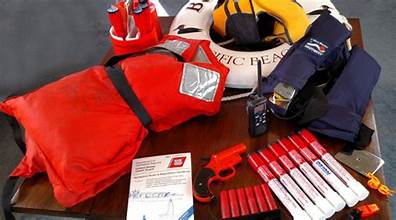
● Pyrotechnic distress flare expiration dates. Also, be sure to check the expiration date when you purchase new, so that you get the maximum benefit.
● LED visual distress signal, electronic flare, and flashlights: Replace batteries.
● VHF handheld radio: Replace batteries, and consider adding reflective tape so if the radio is dropped in water, it will be easier to find.
● Spare hose clamps (marine grade 316 stainless).
● Spare impellers, belts, filters, etc.
● Especially for sailors, check harness, tether and jack lines.
● Perform a radio check (both handheld and permanently affixed). Is your signal strong and clear? If not, there may be some interference that needs to be addressed.
● Inspect the anchor shackle, chain and chain/rode connection. Ensure anchor and rode are ready to deploy in an emergency
● Check your plugs (cone-shaped wooden or soft foam; I have both for different jobs). Are they buried or located conveniently near each thru-hull?
● Make sure the first aid kit has fresh supplies: adhesive bandages that stick, and aspirin and other medications that haven’t expired.
● Ensure the rescue tape is located conveniently (for temporarily handling a hose leak).
● For inflatable life jackets, it’s not only a good idea to check the cylinder cartridge and button date, but also to manually inflate it, and check that it holds air for 24 hours.
● If you have a ditch bag, check its contents, too.
Obviously, the list can go on. You decide what additional equipment and routine checks best suit your needs to keep you, your crew, passengers and vessel safe.
Here’s wishing you an awesome and safe boating season. Have fun, and I look forward to soon seeing you on the water, or at one of the many GLCC events.